
Whether it is 5 PM UTC to EST the same day or 5 PM UTC to the next day, EST, or the other way around; you are not alone in the middle of a very common issue. Time zone calculations may sound easy to use but minor misconceptions may cause actual troubles particularly in work, freelancing or when communicating with people across the globe.
This article simplifies all of this in an easy to understand manner. It will not simply provide you with the answer but will tell you the reasoning behind it, so that you will not have to second-guess yourself once again.
Introduction to UTC and EST
The first thing you have to do to make the conversion is to have a clear vision of what UTC and EST are.
The universal time is UTC or Coordinated Universal Time and is the time that is used to synchronize time around the world. It is not variable by season, i.e. it remains constant all through the year. That’s why airlines, servers, financial systems, and global companies rely on UTC.
EST or Eastern Standard Time is applied in such areas as New York, Toronto and other North American states. Contrary to UTC, EST varies throughout the year as a result of daylight saving time.
EST is 5 hours behind UTC during standard time. However in the months of daylight saving, it switches to EDT (Eastern Daylight Time) 4 hours behind UTC.
It is at this point that most of the confusion starts. It is easy to forget that EST does not maintain all year round.
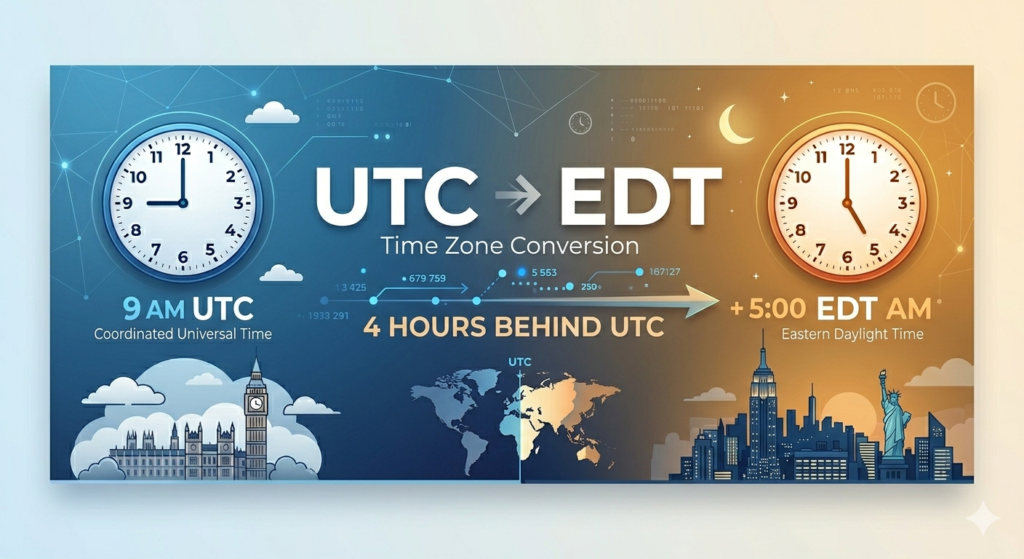
5 PM UTC to EST Same or Next Day
And now we can answer the main question.
To convert 5 PM UTC to EST, the answer depends a little bit on the season, yet it is always the same day.
Under normal time (winter months)
During this time EST is UTC -5.
So:
– 5 PM UTC is 12 PM EST.
– this is midday, evidently of the same calendar day.
There is no transition to the next day since you are time travelling back.
During daylight saving time (summer months)
It is at this time that EST gets transformed to EDT (UTC -4).
So:
– 5 PM UTC is 1 PM EDT.
– Once more this is on the same day.
Final clarity
In either case, 5 PM UTC will always translate to the same day in EST or EDT, no matter the time of the year. No situation when it is made the next day.

Why people think it becomes next day
This misconception is normally caused by confusion between time zones that are beyond UTC.
As an example, such countries as Pakistan or India are a few hours ahead of UTC. By converting UTC to those time zones, it is possible to move the time to the extent that it crosses midnight, changing the date.
It is not always the case that all conversions act in the same manner as people may assume.
In reality:
– UTC time zones may get into the following day.
– UTC time zones such as EST shift to earlier in the same day.
So it is not as much of a confusion when it comes to math as it is to direction.
Real-world example
Well, shall we make it practical?
Suppose that it is Monday today, and an event is planned at 5 PM UTC.
Now convert it:
– During winter: Monday 12 PM EST.
– In summer: Monday 1 PM EDT
In both instances, the occasion remains on Monday.
When it is converted to EST, there is no situation when it would be Tuesday. The only distinction is that it is either noon or early afternoon.
That is why UTC is frequently used by professionals. It is not ambiguous in the case of several regions.
The Importance of This in Business
This may not appear a big point but in the real world, it is a big issue.
Meeting scheduling
In case you are dealing with international teams, you may even miss a whole meeting due to a day mistake. The miscommunication of just a few hours will interfere with coordination.
Deadlines and submissions
Remote workers and freelancers usually deal with clients who are located across time zones. When a deadline is provided in UTC and you get it wrong, then you may end up submitting late without knowing it.
Client trust and professionalism
Consistently, time zone errors may make you seem inconsiderable. There is the need to be accurate among the clients and managers, particularly when it comes to international operations.
Knowing things such as 5 PM UTC time to est same day or next day, will make you not get into such issues at all.
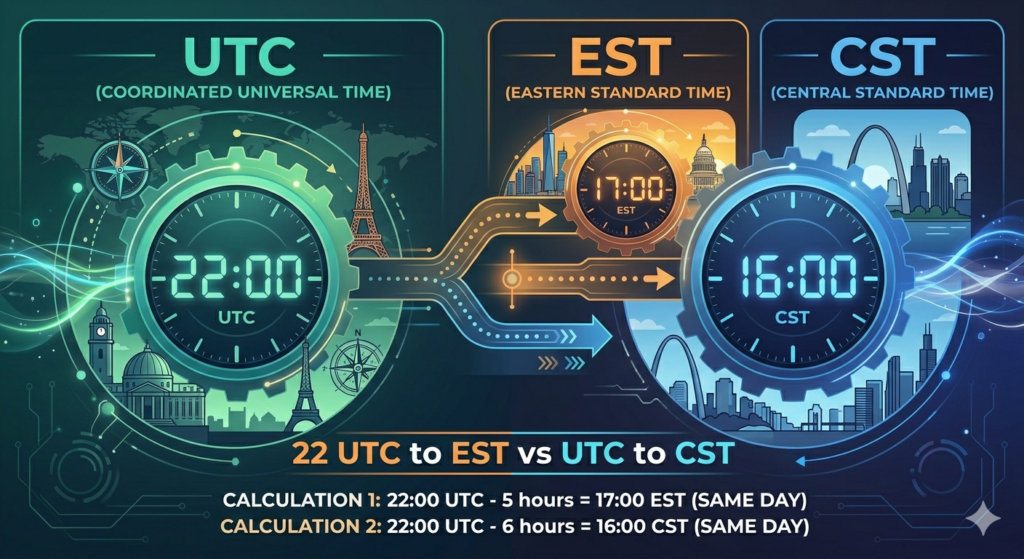
Easy equation to keep in mind
You do not have to memorise various situations, and instead, you can use a simple method.
– in winter: UTC -5 hours.
– In summer: add 4 hours to UTC.
So:
– 5 PM UTC − 5 hours = 12 PM EST
– 5 PM UTC − 4 hours = 1 PM EDT
Since you are subtracting time, you are not going into the next day, but you are going backward in the same day.
Most conversions are made easy by this one single idea.
Tools to avoid mistakes
You may know the concept but it is clever to use tools, particularly in business.
Online converters
Such websites as utctoest offer real-time and precise conversions. You do not have to do any calculations.
Calendar tools
Google Calendar as well as outlook automatically adjust time zones when you set them properly. This is among the safest methods of arranging meetings.
Dual clocks
Having UTC and EST on your machine would enable you to easily compare the time without having to memorize them.
These minor practices minimize the chances of mistakes.
When Does the Date Change?
To comprehend this, it is better to know when the date changes.
Going on ahead.
When you change UTC into a time zone that is a long distance ahead such as UTC +10, then the time might pass through the middle of the night and enter into the next day.
Traveling back in time
When you convert UTC to a time zone that is behind UTC (such as EST), the time will be earlier on the same day.
That is why 5 PM utc to eastern time will never turn out to be the following day but the opposite conversion may act as a counter.
Some of the common mistakes to be avoided.
There are some patterns that recur when individuals commit mistakes.
Forgetting daylight saving
Many think that EST is permanent UTC -5 but during some periods of the year it is UTC -4. Such a difference of one hour is perplexing.
Making guesses rather than calculations
Conversions are frequently estimated by people, rather than verified. This holds until it doesn’t.
Ignoring context
In some cases, individuals are just interested in the hour and forget the date thus making wrong assumptions.
These mistakes are more of awareness.
- Practical scenarios
- Let us relate this to real life scenarios.
- Remote work
In Pakistan (UTC +5) and dealing with an overseas client in the United States:
– 5 PM UTC = 10 PM your time
– 5 PM UTC = 12 PM EST
This makes an overlap of your late evening and their midday.
Online events
UTC is frequently used in webinars and live streams. The fact that 5 PM UTC remains on the same day in EST assists the attendees to participate at the appropriate time.
Project deadlines
When a client has a deadline at 5 PM UTC, you can convert it safely without any fear that the date would be changed in EST.
Reasons Why UTC is Popular
UTC is not a random usage. It is there to ease international coordination.
Rather than making changes to dozens of local time-zones, everything is pegged to a single standard. Each region adapts thereafter.
This system is good, but only when the people know how to convert properly.
Best Practices to be More Explicit
To eliminate any confusion, there are a few simple habits to observe.
- Always make sure that the time zone is added.
- Always avoid writing at 5 PM. Always mention whether it is UTC, EST or not.
- Provide dual timing
- When planning something, mention both UTC and local time.
- Double-check critical timings
Whenever you need to have an important meeting or meet a deadline, it is always important to check the conversion with the help of a tool.
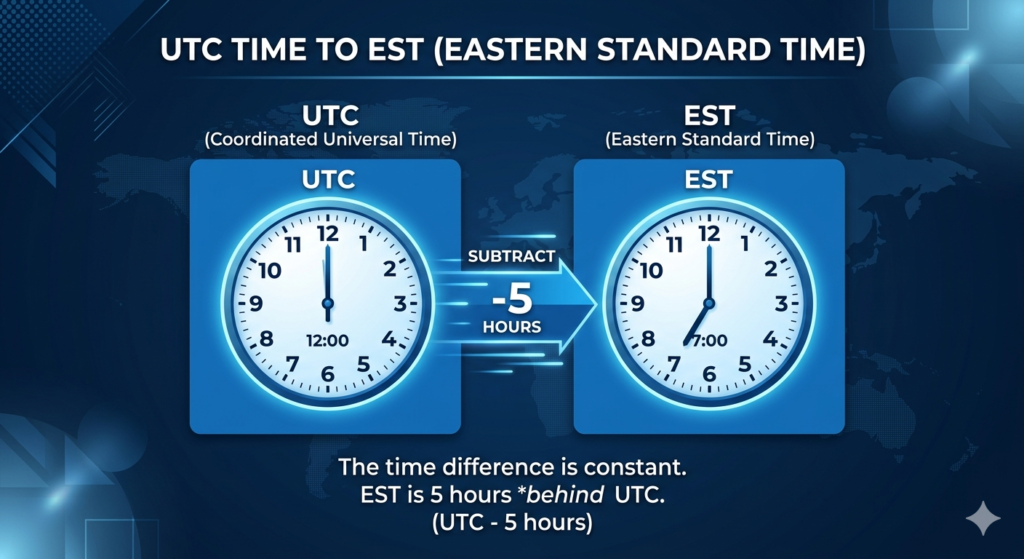
Summary
Now, one more time, let us be as clear as thieves and thieves.
PM 5 utc will be equivalent to PM 12 EST during winter.
– 5 PM UTC is 1 PM EDT during summer.
– In both, it is on the same day.
Thus, 5 PM UTC to EST same day or next day is a simple question to answer: it is never the same day.
This ceases to be confusing once you get the orientation of time zones.
FAQs
Does 5 pm UTC become the next day in EST?
No, it does not. As EST is never behind UTC, the time will always remain on the same day.
At what time is 5 PM UTC EST on daylight saving?
UTC Eastern time turns into 1 PM EDT, yet it remains on the same day.
Why are people puzzled over this conversion?
The major confusion arises when time zones that are ahead of UTC and behind UTC are confused.
Is EST five hours less than UTC all the time?
No. It becomes four hours behind in daylight saving months and is known as EDT.
How can time zones be changed in the safest manner?
Employing credible tools such as online converters or calendar applications make it accurate and eliminate errors.
Final Thoughts
Time zone confusion is not so much a matter of complexity as it is a matter of clarity. When you know the way of conversion, anything is foreseeable. The 5 PM UTC to EST either same day or next day is simple in this case since ESTs always follow UTC. The fact alone leaves no doubt.
What this conversion teaches us is not only this conversion, but how to deal with time zones in general. Think in offsets and direction, rather than guess or memory. Are you going through time forward or backward? The problem can be answered with that question.
This is more important than it appears to be, should you work, study or otherwise interact with people in various regions. Even a minor time mistake may impact meetings, deadlines and professional credibility. Conversely, time management is the way to go because it makes one appear efficient and dependable.
Therefore do not make it too difficult. Always keep the rule simple, remember to check twice and apply tools like UTC to EST when you need accuracy. When you develop such a habit, such conversions cease to be baffling and begin to become a matter of habit.