
The difference in UTC vs EST key is more important than many may think. You may be arranging meetings, conducting business worldwide or you may be working in a different time zone, knowing how these two time standards operate can help you avoid expensive mistakes.
Time is not simply a figure on a clock. They influence communication, business processes and even personal productivity. However, UTC to EST are often mistaken by many individuals who believe that they can be used interchangeably. They are not.
The article simplifies it into a practical manner so that you can not only comfortably use both, but also not doubt yourself when using either.
What Is UTC
All countries synchronize their local time with UTC.
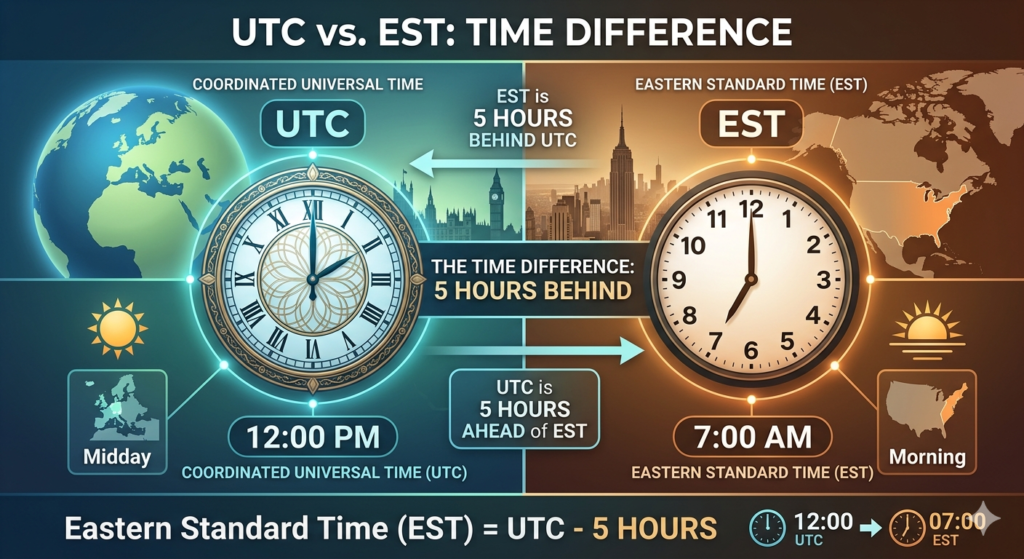
UTC does not vary with the year. It remains unchanged, irrespective of seasons or the daylight saving changes.
Consider UTC to be the keystone of world time. It is stable and predictable and airlines, tech systems, and international organisations use it.
What Is EST
Eastern Standard Time or EST is a local time zone adopted in North America mostly in the eastern region. It is popular in such cities as New York, Toronto, and even on some islands of the Caribbean.
EST is 5 hours behind the UTC. So when it is 12:00 UTC, it is 7:00 AM EST.
EST is not however always used all through the year. It changes to Eastern Daylight Time (EDT) (UTC -4 hours) during daylight saving time.
UTC vs EST Key Differences
Comparing the UTC vs EST key differences, the key difference is noted to be in stability versus variability.
UTC is unchanged throughout the year. EST varies with daylight saving time.
This disparity may cause confusion in scheduling, particularly when scheduling across regions. When a person refers to EST in summer, he/she may mean EDT.
The major differences are in the following simple terms:
UTC is an international standard.
EST is a local time zone.
UTC never changes
EST changes with the time of daylight saving.
Applications of UTC are in Technical Systems
EST has been applied in our everyday life in certain areas.
The knowledge of this alone can help in avoiding numerous scheduling mistakes.
Time Difference Explained
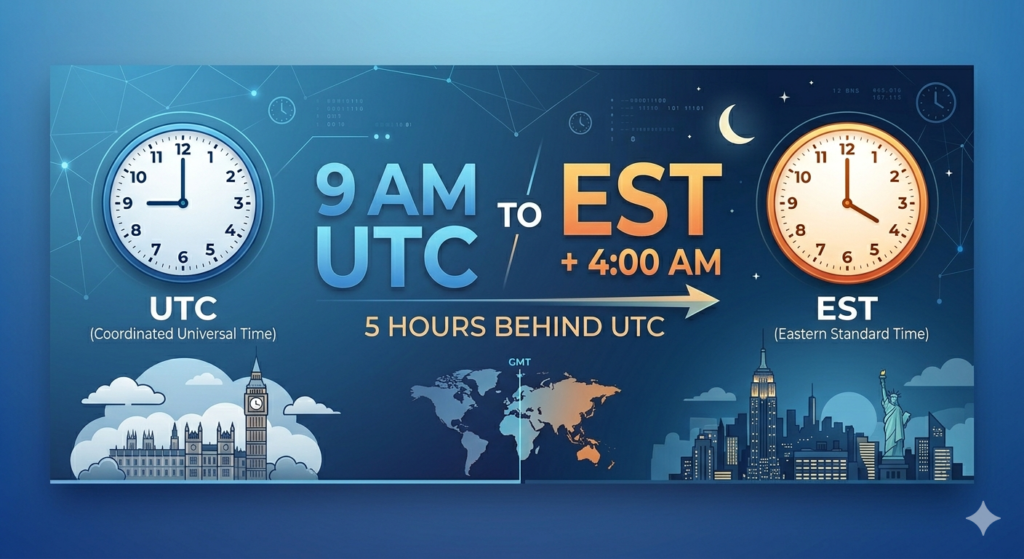
The UTC and EST time difference normally stand at 5 hours.
UTC = EST + 5 hours
For example:
10:00 UTC = 5:00 AM EST
18:00 UTC = 1:00 PM EST
Under daylight saving time, the difference will be 4 hours since the EST will change to EDT.
That means:
10:00 UTC = 6:00 AM EDT
It is in this change that most confusion occurs.
The Reason Why UTC is in Use All Over the World
UTC is used in global coordination as it eradicates ambiguity.
Consider operating a worldwide server system. This would be a nightmare in case every system used local time to synchronise. UTC resolves this by offering a single reference.
The high dependence industries on UTC are:
- Aviation
- Cloud systems and technology.
- Financial markets
- Scientific research
Applying UTC makes everyone on the same page, no matter where they are.
The Importance of EST Today
However, despite the fact that UTC is the international standard, EST has a significant role in day-to-day life.
Individuals in the eastern region of North America dwell by EST or EDT. This local time is observed in businesses, schools and even the media schedules.
In the case of an announcement of an event, e.g., at 9 AM EST, the event is targeted to a particular audience in that area.
So UTC is universal whereas EST is practical and localised.
An Effect on the Daylight Saving
It is in daylight saving time that it becomes tricky.
During warmer months, EST changes to EDT and this is usually between the months of March and November.
This implies that clocks advance an hour. As a result:
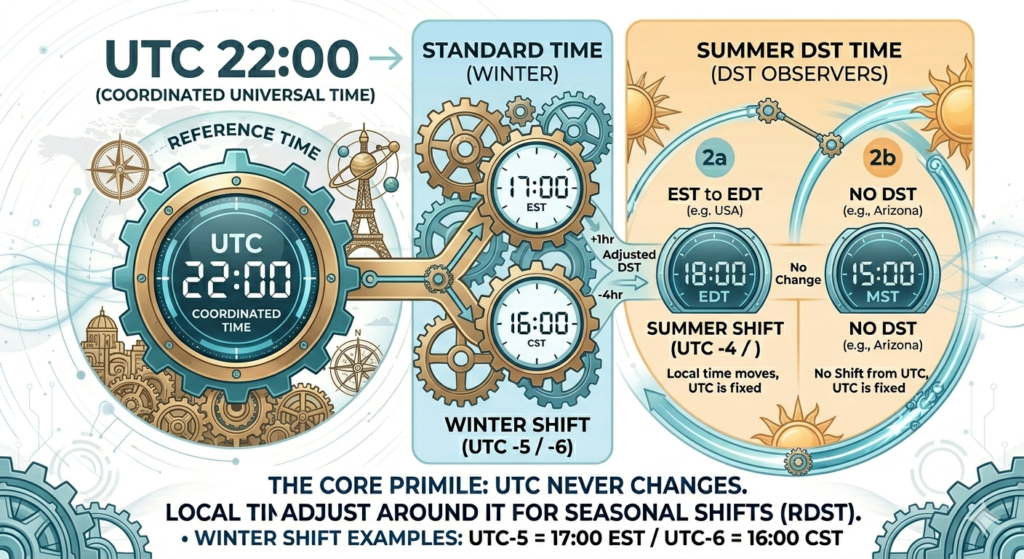
EST (UTC -5) becomes EDT (UTC -4)
Failure to take note of this change may mean that you will be either an hour early or late to important meetings.
This is one of the mistakes that many people commit since they still use EST when EDT is still active.
Incorporate These Most Frequent Errors
UTc and EST are confused even among the seasoned professionals. The following are some of the pitfalls:
Using EST year-round
It is technically incorrect to say EST even in daylight saving time.
Unremembering the time change.
Failure to make adjustments to EDT may result in missed deadlines or meetings.
Assuming UTC changes
UTC does not vary, yet a lot of people believe that it does adhere to daylight-saving regulations. It does not.
Ignoring conversion tools
Hand calculations put at risk the possibility of error, particularly between time zones.
Conversion of UTC to EST
After learning the fundamentals, converting UTC to EST will be simple:
Confirm whether it is currently daylight savings time.
If so, subtract 5 hours (if not) or 4 hours (daylight savings).
Some dates require you to adjust accordingly.
Example:
In case it is 2:00 UTC, deduct 5 hours.
That puts you at 21:00 EST (past day)
It might be inconsequential, yet a shift in dates can bring about enormous confusion with the scheduling.
Practical Use Cases
Knowledge about UTC vs EST key differences is not a mere theory. It is applicable in the real world.
Remote work
Teams operating on a global scale need proper time conversion.
Freelancing
Clients can set deadlines using UTC but you are in EST.
Trading
Financial markets work under rigid time constraints, and often use UTC.
Travel
Flight schedules are often based on UTC to prevent confusion between time zones.
In each of these situations, being aware of the difference can save time and avoid errors.
Suggestions on How to Prevent Confusion
Time zones do not always work well, and a couple of habits will facilitate the process.
Always make sure to check the time zone.
Do not guess if it is UTC, EST, or EDT.
Use calculators such as utctoest.com.
Trustworthy converters help to minimize manual mistakes.
name two time zones.
As an illustration, 3 PM EST (8 PM UTC) is very clear.
Remember daylight saving changes.
Make sure that you put these dates in your calendar.
Technology UTC vs EST
UTC is the default in tech systems.
Time is normally stored in UTC in servers, databases and APIs. This helps in avoiding time zone changes leading to inconsistencies.
The systems change UTC to local time such as EST when showing time to users.
This method maintains data stability as well as gives a friendly user experience.
Which of the Two to Use?
It depends on your circumstances.
Work globally or dealing with technical systems, use UTC. It is specific and universal.
EST is to be used in the eastern North American region with local audiences.
In case of indecision, add both. It is least harmful.

The Bigger Picture
Offsets are not the only time zones. They mirror the world-coordination.
UTC offers a consistent platform, and EST is responsive to the local demands.
Knowing both will put you at an edge, particularly in a world where remote employment and international communication are becoming a standard.
FAQs
What is the primary distinction between UTC and EST
UTC is a universal time that does not vary and EST is a local time that varies during daylight saving time.
Why UTC, and not EST?
UTC is uniform and stable, and is suited to international coordination and technical systems.
Is EST applicable in summer?
Technically, no. EDT, not EST, is used in summer.
Final Thoughts
UTC provides you with uniformity. EST provides you with local relevance. They should not be mixed up as it can be confusing, however, when used properly, it can make your work easier and more professional.
When you have to work with time zones frequently, spare yourself a few minutes and check conversions. It is a little thing that can keep large things at bay.
You can make your life much easier with such tools as UTC to EST to make quick and accurate conversions.
Visit for more : UTC Time