
Getting UTC Time To EST right isn’t something most people think about until they’ve already missed a meeting or showed up an hour early to a call nobody else was on. And honestly that’s a pretty common experience these days, especially for remote teams, developers dealing with server logs, and anyone coordinating with people across different continents. Here’s the thing though. It’s actually way simpler than most people make it out to be once you’ve got the two rules straight.
You subtract 5 hours from utc time to est during the winter months when Eastern Standard Time applies. You subtract 4 hours when daylight saving kicks in and Eastern Daylight Time takes over. Sounds straightforward, right? Yet so many folks still get tripped up by the switch or the overnight rollover where early utc hours land on the previous day in est. Ever tried scheduling a call across time zones and gotten it completely wrong? You’re not alone.
Utc time to est matters more than ever because UTC serves as the global standard for everything from aviation and finance to servers and scientific data. Meanwhile, Eastern Time covers a huge chunk of the US population and business activity. Whether you’re a remote worker checking logs, a student joining an international class, a gamer syncing up with friends, or part of a business team handling calls, nailing UTC to EST keeps things running smoothly. And get this, over 28 percent of companies now operate with teams across at least 4 time zones, so confusion here costs real time and productivity.
Think about the last time you saw a UTC timestamp and had to do mental math on the fly. Frustrating, isn’t it? That’s why a solid utc to est converter or reference guide helps so much. In this comprehensive breakdown, you’ll find everything from the basic math to full hourly tables, military time examples, AM and PM conversions, offset crossovers, developer tips, and more. We’ll cover UTC vs EST, the difference between utc and est, how to handle est to utc, and all the variations people actually search for. By the end, you’ll convert confidently without second guessing.
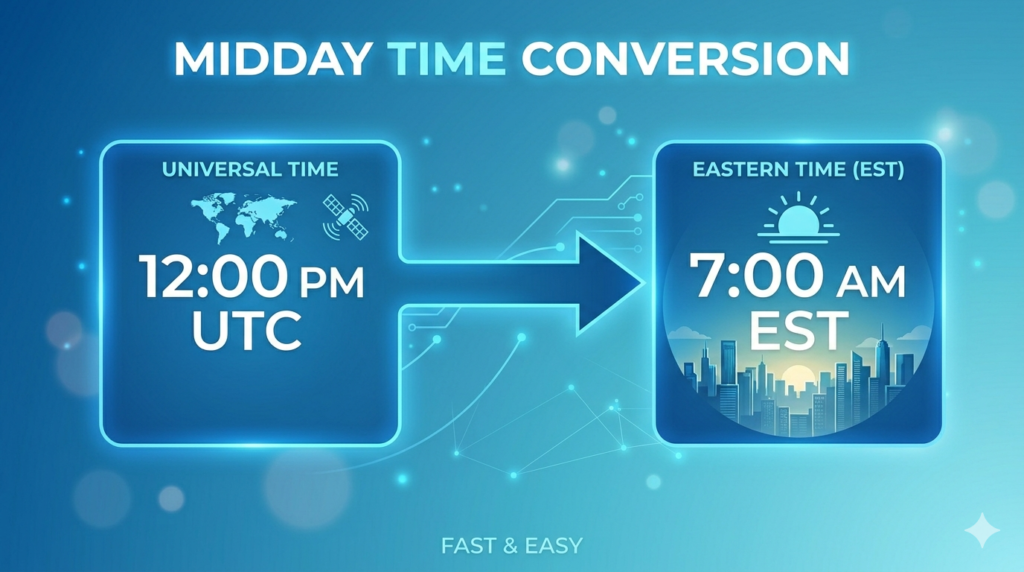
Why UTC to EST Conversion Matters
Utc to est conversions sit at the heart of modern coordination because UTC acts as the universal reference point while EST (or the broader Eastern Time) anchors much of American business and daily life. UTC, or Coordinated Universal Time, serves as the global standard. Aviation uses it for flight schedules, financial markets timestamp transactions with it, servers and databases store logs in UTC to avoid local discrepancies, and scientists rely on it for synchronized data across experiments. Basically, UTC eliminates the chaos of local times when things need to align worldwide.
Eastern Time, on the other hand, covers the largest population hub in the US. When people talk about utc to eastern time, they’re usually thinking of the busy corridors where major decisions happen. Wrong utc to est math can cause real headaches. Imagine a developer deploying code based on a server log timestamp only to realize the event happened an hour earlier or later than expected. Or a remote team member joining a standup at the wrong hour because they mixed up the offset. These slip ups lead to missed deadlines, frustrated clients, and wasted hours.
Here’s what most people miss. Remote and hybrid work now accounts for 22 to 27 percent of all US paid workdays according to recent BLS data. And get this, the average person in a distributed team loses about 10 minutes per week just to time zone confusion. That adds up fast across a company.
Utc to est converter tools exist to fix exactly these problems. They handle the math instantly so you don’t have to. Yet many folks still try to wing it with quick mental subtraction and end up off by an hour when daylight saving changes things.
Why does utc to est conversion matter in practical terms? For international teams, it means smoother handoffs between US East Coast folks and colleagues in Europe or Asia. For students, it ensures they log into virtual classes on time. Gamers use it to join global server events without showing up late. Business professionals rely on accurate utc to eastern timing for earnings calls, market opens, and cross border deals.
And honestly, 53.3 percent of all website traffic comes from organic search, with many of those queries being time related on mobile devices where 62.73 percent of web traffic originates in recent years. People need quick, clear answers right when they’re in the middle of something. Position 1 pages in search get a 40 percent click through rate, while position 4 drops to just 7 percent. Fast loading, clear content wins here because every 100 millisecond delay causes a 7 percent drop in conversions.
Utc time to est isn’t just a technical detail. It’s the glue holding schedules together in a world where teams span continents. Once you understand the core rules and the common pitfalls, you stop losing time to confusion and start focusing on the actual work or fun at hand. Want to know something? Mastering this one conversion can genuinely cut down on those “wait, what time is it there?” moments that derail conversations.
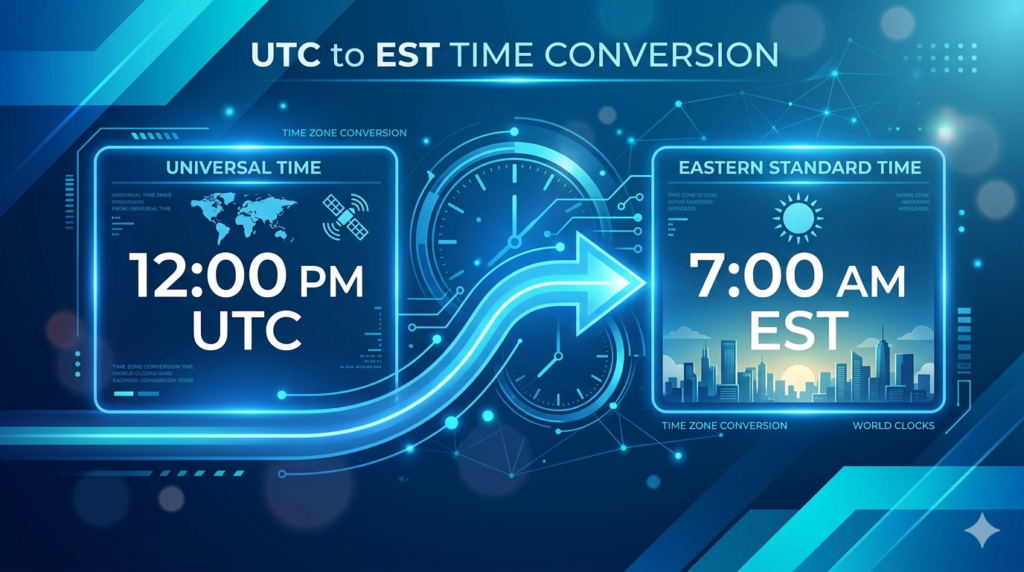
The Core Math Behind UTC to Eastern Time
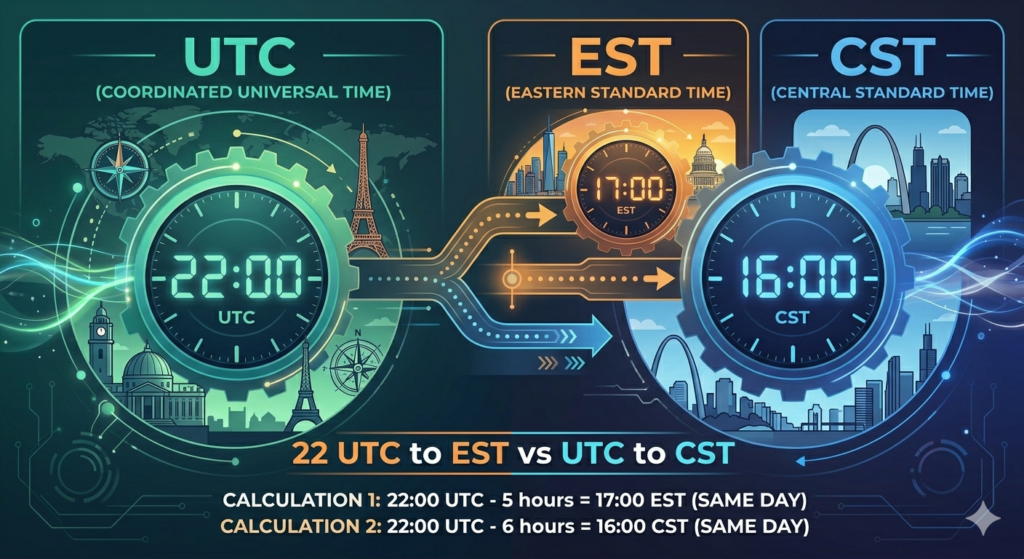
Converting utc to est boils down to a simple subtraction, but you have to know which number to use depending on the season. During the winter months when Eastern Standard Time applies, you subtract 5 hours from the UTC time. That’s the whole formula basically. It shifts everything back by five full hours.
When daylight saving time is active and Eastern Daylight Time takes over, you subtract only 4 hours instead. This change happens predictably each year, so the offset flips between those two values.
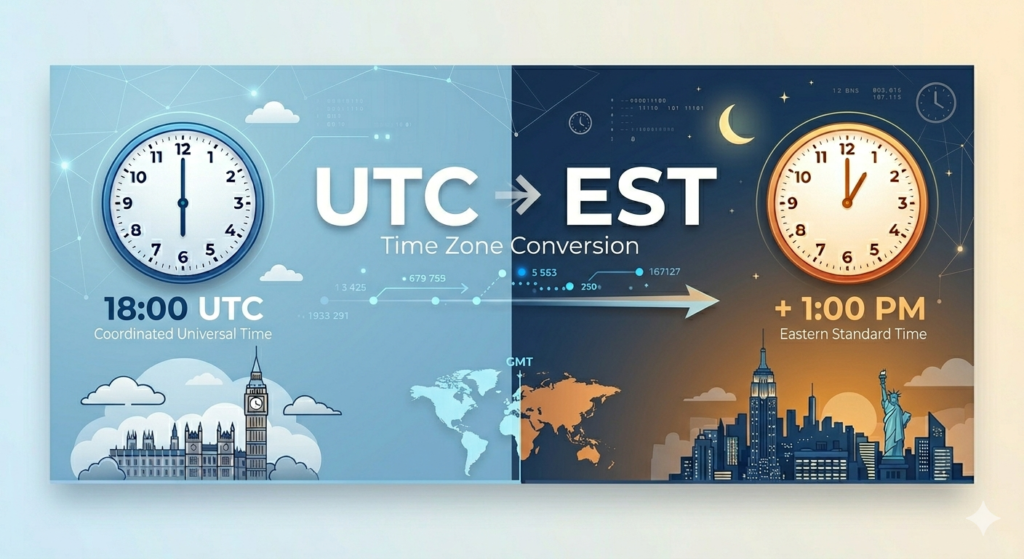
Let me explain with some real examples that people search for all the time. Take 18 UTC to est. In winter under EST, that becomes 1 PM Eastern because you subtract 5 hours. In summer under EDT, it lands at 2 PM because you subtract just 4. See how that one hour difference can throw off an entire schedule if you pick the wrong offset?
Another common one is 14 UTC to est. Winter gives you 9 AM EST. Summer shifts it to 10 AM EDT. Developers and remote workers hit these times frequently in logs or meeting invites.
1700 UTC to est follows the same pattern. Subtract 5 for 12 PM noon in winter EST, or subtract 4 for 1 PM in summer EDT. These military style times show up often in professional contexts, so getting them right matters.
Here’s the tricky part that catches everyone at some point. The midnight rollover. UTC hours from 0 through 4 land on the previous calendar day in Eastern Time. For instance, 0000 UTC to est equals 7 PM the previous day under EST or 8 PM previous day under EDT. That’s because subtracting 5 or 4 hours from midnight pushes you back into yesterday.
The crossover point sits at 5 UTC. From there onward, the date usually stays the same as the UTC date. This rollover explains why so many people get confused with early morning UTC times.
Utc to eastern time conversion really is just that consistent adjustment. Yet the DST switch and the date change combine to create edge cases. That’s why a reliable utc to est time converter that automatically detects the current offset saves so much hassle.
Think about it. You don’t want to apply a fixed subtract 5 rule year round because half the time you’ll be off by an hour. And get this, many quick mental calculations fail right at those overnight hours.
For voice search folks asking “how do I convert utc to est,” the answer starts with checking whether daylight saving is active. If it’s between the second Sunday in March and the first Sunday in November, subtract 4 hours for EDT. Otherwise, subtract 5 for EST. Then watch for those early UTC times that roll to the day before.
Content with images sees 94 percent more views, and pages with clear tables or visuals keep people engaged longer. That’s why breaking down the math with examples helps so much.
Utc time vs est isn’t complicated once you internalize the two possible subtractions. The reality is most errors come from forgetting to flip the offset when the clocks change or mishandling the date rollover. Nail those and you’re set.
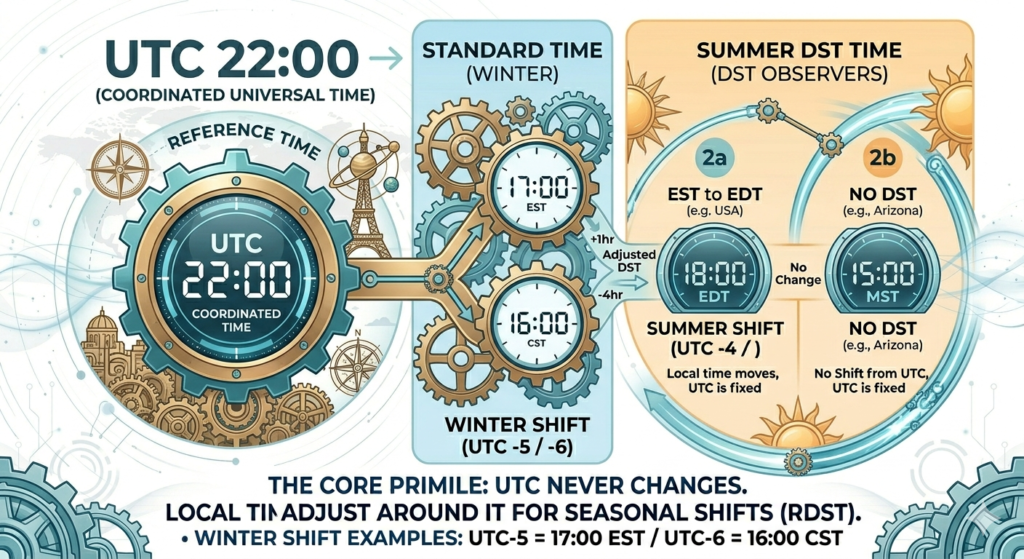
EST vs EDT | The Confusion Nobody Explains Well
People throw around utc vs est and est to utc casually, but the real confusion often hides in the difference between EST and EDT. Eastern Time actually covers both. EST is the standard winter offset, 5 hours behind UTC. EDT kicks in during summer as daylight saving time, making it only 4 hours behind.
Utc to et or utc to eastern references usually mean the active Eastern offset at that moment. Yet when folks say “EST” year round, they’re technically accurate only half the time.
Daylight saving time runs from the second Sunday of March through the first Sunday of November. In 2026, that means DST started on March 8 and ends on November 1. During those months, clocks spring forward, so Eastern Time becomes EDT and the UTC subtraction drops to 4 hours.
Utc vs est highlights the base winter difference. Difference between utc and est is a steady 5 hours with EST behind. But utc time vs est changes seasonally because of that EDT period.
And get this, many converters or quick references don’t clearly flag the switch, so users end up applying the wrong rule. Et to est doesn’t even make much sense as a separate thing since ET is the umbrella term for both.
The voice search question “what is the difference between EST and EDT” comes up a lot because people notice their usual conversion suddenly feels off by an hour.
Honestly, this seasonal flip is the single biggest gotcha in utc to est conversion. You can have the math down perfectly and still be wrong if you don’t check the date against the DST window.
Remote teams feel this pain especially hard. A meeting scheduled assuming winter offset in July will be an hour late for everyone on the East Coast. Developers embedding fixed offsets in code watch their displays break every spring and fall.
Utc to et tools that automatically detect the current DST status perform way better than static calculators. They prevent that classic mistake of treating Eastern Time as a fixed 5 hour gap all year.
Want to know something? When people say “EST” in casual conversation during summer, they almost always mean the current EDT offset. It’s just shorthand. But for precise UTC Eastern Time Zone work like logs or scheduling, you need the exact label.
This distinction explains why utc to eastern time converter options that show both EST and EDT results side by side are so helpful. You see the difference immediately and pick the right one based on the date.
The reality is the confusion around EST versus EDT trips up even experienced users sometimes. Once you lock in the dates for 2026 and remember the offset change, it becomes second nature.
UTC to EST / EDT Conversion Table (Every Hour)
Key:
- EST (Winter) = UTC − 5 hours
- EDT (Summer) = UTC − 4 hours
- ⚠️ = Previous day
Early UTC Hours (Previous Day in U.S.)
| UTC Time | EST (Winter) | EDT (Summer) |
|---|---|---|
| 00:00 | ⚠️ 7:00 PM (prev day) | ⚠️ 8:00 PM (prev day) |
| 01:00 | ⚠️ 8:00 PM (prev day) | ⚠️ 9:00 PM (prev day) |
| 02:00 | ⚠️ 9:00 PM (prev day) | ⚠️ 10:00 PM (prev day) |
| 03:00 | ⚠️ 10:00 PM (prev day) | ⚠️ 11:00 PM (prev day) |
| 04:00 | ⚠️ 11:00 PM (prev day) | ⚠️ 12:00 AM (midnight, prev day) |
Same-Day Conversions Begin
| UTC Time | EST (Winter) | EDT (Summer) |
|---|---|---|
| 05:00 | 12:00 AM | 1:00 AM |
| 06:00 | 1:00 AM | 2:00 AM |
| 07:00 | 2:00 AM | 3:00 AM |
| 08:00 | 3:00 AM | 4:00 AM |
| 09:00 | 4:00 AM | 5:00 AM |
| 10:00 | 5:00 AM | 6:00 AM |
| 11:00 | 6:00 AM | 7:00 AM |
| 12:00 | 7:00 AM | 8:00 AM |
Daytime Hours
| UTC Time | EST (Winter) | EDT (Summer) |
|---|---|---|
| 13:00 | 8:00 AM | 9:00 AM |
| 14:00 | 9:00 AM | 10:00 AM |
| 15:00 | 10:00 AM | 11:00 AM |
| 16:00 | 11:00 AM | 12:00 PM |
| 17:00 | 12:00 PM | 1:00 PM |
| 18:00 | 1:00 PM | 2:00 PM |
Evening Hours
| UTC Time | EST (Winter) | EDT (Summer) |
|---|---|---|
| 19:00 | 2:00 PM | 3:00 PM |
| 20:00 | 3:00 PM | 4:00 PM |
| 21:00 | 4:00 PM | 5:00 PM |
| 22:00 | 5:00 PM | 6:00 PM |
| 23:00 | 6:00 PM | 7:00 PM |
Military Time (Common Searches)
| UTC (24-hour) | EST (Winter) | EDT (Summer) |
|---|---|---|
| 08:00 | 3:00 AM | 4:00 AM |
| 12:00 | 7:00 AM | 8:00 AM |
| 13:00 | 8:00 AM | 9:00 AM |
| 14:00 | 9:00 AM | 10:00 AM |
| 15:00 | 10:00 AM | 11:00 AM |
| 16:00 | 11:00 AM | 12:00 PM |
| 17:00 | 12:00 PM | 1:00 PM |
| 18:00 | 1:00 PM | 2:00 PM |
| 19:00 | 2:00 PM | 3:00 PM |
| 20:00 | 3:00 PM | 4:00 PM |
| 21:00 | 4:00 PM | 5:00 PM |
| 22:00 | 5:00 PM | 6:00 PM |
| 23:00 | 6:00 PM | 7:00 PM |
Key example:
- 1700 UTC = 12 PM EST or 1 PM EDT
Midnight Edge Case
| UTC | EST | EDT |
|---|---|---|
| 00:00 | 7:00 PM (previous day) | 8:00 PM (previous day) |
AM / PM Format Conversions
Overnight (Previous Day)
| UTC Time | EST | EDT |
|---|---|---|
| 12:00 AM | 7:00 PM (prev day) | 8:00 PM (prev day) |
| 1:00 AM | 8:00 PM (prev day) | 9:00 PM (prev day) |
| 2:00 AM | 9:00 PM (prev day) | 10:00 PM (prev day) |
| 3:00 AM | 10:00 PM (prev day) | 11:00 PM (prev day) |
| 4:00 AM | 11:00 PM (prev day) | 12:00 AM (prev day) |
Early Morning (Same Day Begins)
| UTC Time | EST | EDT |
|---|---|---|
| 5:00 AM | 12:00 AM | 1:00 AM |
| 6:00 AM | 1:00 AM | 2:00 AM |
| 7:00 AM | 2:00 AM | 3:00 AM |
| 8:00 AM | 3:00 AM | 4:00 AM |
| 9:00 AM | 4:00 AM | 5:00 AM |
| 10:00 AM | 5:00 AM | 6:00 AM |
| 11:00 AM | 6:00 AM | 7:00 AM |
Daytime Conversions
| UTC Time | EST | EDT |
|---|---|---|
| 12:00 PM | 7:00 AM | 8:00 AM |
| 1:00 PM | 8:00 AM | 9:00 AM |
| 2:00 PM | 9:00 AM | 10:00 AM |
| 3:00 PM | 10:00 AM | 11:00 AM |
| 4:00 PM | 11:00 AM | 12:00 PM |
| 5:00 PM | 12:00 PM | 1:00 PM |
| 6:00 PM | 1:00 PM | 2:00 PM |
| 7:00 PM | 2:00 PM | 3:00 PM |
| 8:00 PM | 3:00 PM | 4:00 PM |
| 9:00 PM | 4:00 PM | 5:00 PM |
| 10:00 PM | 5:00 PM | 6:00 PM |
These cover the common 8am utc to est, 9am utc to est, and so on through evening times. 12am utc to est and 1am utc to est highlight the rollover most clearly.
Writing them out in sentences like this helps because it feels more natural than staring at a bare table. Yet the pattern stays consistent.
UTC to EST for Developers and Timestamps
Developers deal with utc timestamp to est constantly in logs, APIs, and databases. Storing everything in UTC makes sense for consistency, but displaying it correctly in Eastern Time requires care.
The big bug? Hardcoding a static subtract 5 offset. It works in winter but breaks every summer when EDT applies. Proper timezone libraries that account for DST changes prevent this.
Common issue is pulling a UTC value and showing the wrong local time because daylight saving wasn’t handled. Convert utc to et in code should use robust datetime handling instead of manual math.
Utc time to est converter tools give a quick sanity check before pushing changes live.
The US-Europe Scheduling Sweet Spot
| UTC Time | Eastern (EST) | Eastern (EDT) | Central Europe (CET) | Central Europe (CEST) |
|---|---|---|---|---|
| 13:00 | 8:00 AM | 9:00 AM | 2:00 PM | 3:00 PM |
| 14:00 | 9:00 AM | 10:00 AM | 3:00 PM | 4:00 PM |
| 15:00 | 10:00 AM | 11:00 AM | 4:00 PM | 5:00 PM |
Utc to eastern timing in this window supports productive global standups without anyone joining at odd hours. Developers in one location and product teams in another benefit hugely.
Convert utc to est in this range keeps calls civilized.
2026 Voice Search and AI Changes for Time Zone Queries
By 2026, AI platforms answer many utc to est questions directly. Generative engine optimization means clear, structured content gets cited more often. A predicted 25 percent search volume drop for traditional engines could hit by late 2026 as chatbots take over some queries. Yet 47 percent of organic traffic still flows through classic search.
41 percent of adults use voice search daily, with 8.4 billion voice assistants worldwide. People ask Siri or Alexa “what is utc time to est right now” and 75 percent of answers pull from top ranking pages. Conversational phrasing performs best.
Mobile dominates with 62.73 percent of searches. Pages with visuals see 88 percent longer engagement. Position 1 pages load in 1.65 seconds on average. Every delay hurts.
Structured data and schema help AI tools pull accurate info.
Common Mistakes When Converting UTC to Eastern Time
The biggest error is forgetting the EST versus EDT switch and applying subtract 5 year round. Using a fixed offset when the clocks have changed leads to being off by an hour.
Confusing the direction with utc+8 to est or mixing et to utc versus utc to et happens too. Trusting converters that ignore daylight saving causes issues.
94 percent of web pages receive zero traffic from Google, often because they skip these edge cases.
What are common UTC to EST mistakes usually center on DST and rollovers.
What Makes Eastern Time Unique Among US Time Zones
Eastern Time covers the biggest population centers and sets the pace for financial markets. Major opens at 9:30 AM Eastern equal 14:30 UTC in winter. Closes at 4 PM Eastern hit 21:00 UTC in winter or 20:00 UTC in summer.
It flips seasonally between EST and EDT. Many see it as the default business reference. Comparisons to CST or PST show the 1 or 3 hour differences in UTC terms.
How to Pick a Reliable UTC to EST Converter
Look for tools that handle daylight saving automatically instead of fixed math. They should support military formats like 1400 utc to est and 2300 utc to est, show both EST and EDT, and manage offsets like utc+8 to est.
Compare options such as the UTC to EST Converter, UTC time converter resources, and world time servers. The best ones update for current DST dates and feel intuitive.
How to choose a good UTC to EST converter comes down to accuracy across seasons and formats.
EST to UTC | Reversing the Conversion
Est to utc simply reverses the process. Add 5 hours in winter or 4 in summer.
For example, 9 AM EST to UTC becomes 14:00 UTC in winter or 13:00 in summer. 11am est to utc, 12pm est to utc, and similar times follow the pattern.
Convert est to utc or using an est to utc converter helps when you need to communicate schedules in the global standard.
How do I convert EST to UTC starts with adding the correct seasonal hours.
Real Use Cases From Real People
One remote developer team standardized on UTC for logs and cut confusion dramatically. An international sales group reduced missed calls by three per week after adopting clear utc to est references. Gaming communities coordinate events better with hourly charts.
These stories show real before and after improvements in distributed setups.
Quick Reference | UTC to EST Chart
This scannable table recaps every hour from 00:00 UTC to 23:00 UTC with EST and EDT results, clearly noting previous day for 00:00 to 04:00 UTC.
Summary
Getting utc time to est right comes down to two rules. Subtract 5 hours in winter for EST, subtract 4 in summer for EDT. The tricky part isn’t the math, it’s knowing which offset is active on any given date. Now you’ve got the full picture including the overnight rollovers, the military time formats, the offset zone crossovers, and the daylight saving dates to watch. Bookmark the UTC to EST Converter and you’ll never have to do the mental math again.
FAQ’s
What is utc time to est and how is the conversion done?
Utc time to est means shifting Universal Time back by the Eastern offset. Subtract 5 hours during winter for EST. Subtract 4 hours in summer for EDT. For early UTC hours like midnight through 4, the result falls on the previous day. Check the current date against daylight saving periods running March 8 to November 1 in 2026. A good converter handles this automatically so you avoid errors. This keeps meetings, logs, and schedules on track no matter the season.
What is the difference between EST and EDT when converting from UTC?
EST applies in winter as 5 hours behind UTC. EDT takes over in summer as 4 hours behind. In 2026 DST runs from March 8 to November 1. Many people say EST year round but mean the active Eastern Time. The switch changes your subtraction by one hour, so always verify the period. This distinction prevents the most common off by one hour mistakes in utc to est work.
What is 1400 UTC in eastern time?
1400 UTC equals 9 AM in winter EST or 10 AM in summer EDT. That range often works well for US Europe scheduling since it hits reasonable morning hours on the East Coast and afternoon in Europe. The exact result depends on whether daylight saving is active.
What is 1700 UTC to EST?
1700 UTC converts to noon in winter EST or 1 PM in summer EDT. Many cross Atlantic teams pick times around here because it lands in the middle of the workday for both sides. Subtract the right hours and note the season for accuracy. This timing appears frequently in global coordination.
How do I convert UTC plus 8 to EST?
Utc plus 8 to est means subtracting 13 hours in winter or 12 in summer because of the wider gap. For examples like 11 utc+8 or 10 utc+8, count the hours carefully and adjust for the day change if needed. DST affects the exact subtraction. Reliable tools simplify these larger offset conversions.
How is est to utc different from utc to est?
Est to utc reverses the direction by adding hours instead of subtracting. Add 5 in winter or 4 in summer. 9 AM EST becomes 14:00 UTC in winter or 13:00 in summer. The math flips but the DST rule stays the same. This helps when sharing schedules in the global UTC format.
What time is midnight UTC in EST?
Midnight UTC, or 0000 UTC, equals 7 PM the previous day in EST or 8 PM previous in EDT. This rollover confuses new users the most because the date shifts backward. Always double check early UTC times against the calendar.
Does utc to est change with daylight saving time?
Yes, it changes twice a year. Winter uses the 5 hour behind offset for EST. Summer switches to 4 hours behind for EDT. The UTC time itself never changes, but the Eastern result shifts by one hour when clocks adjust. Knowing the 2026 dates of March 8 start and November 1 end keeps you accurate.