
Getting UTC time to EST right isn’t something most people think about until they’ve already missed a meeting or showed up an hour early to a call nobody else was on. And honestly that’s a pretty common experience these days, especially for remote teams, developers dealing with server logs, and anyone coordinating with people across different continents. Here’s the thing though. It’s actually way simpler than most people make it out to be once you’ve got the two rules straight. You basically subtract five hours during the winter months for EST or four hours in the summer for EDT. And get this, a surprising fact is that UTC serves as the global standard for aviation, finance, and servers worldwide, keeping everything synchronized no matter where you are. Ever tried scheduling a call across time zones and gotten it completely wrong? You’re not alone. This guide walks you through everything you need for smooth UTC to EST conversions.
Why UTC to EST Conversion Matters
UTC time to EST matters more than ever because so many of us work, play, and connect across borders these days. Think about it. Remote workers check server times, business professionals join international meetings, developers debug logs, students submit assignments on deadline, gamers coordinate raids, and international teams sync up without chaos. UTC acts as the universal reference time that aviation uses for flights, financial markets rely on for trades, and computer servers worldwide timestamp everything against. It’s the anchor that prevents total confusion in our connected world.
Eastern Time covers the largest population hub in the US, so getting the conversion right affects New York meetings, Boston calls, Atlanta schedules, and Miami plans all at once. Wrong conversions cause real headaches like missed job interviews, botched financial reports, or servers showing data from the wrong day. And get this, over 28 percent of companies now operate with teams across at least four time zones. Remote and hybrid work sits at 22 to 27 percent of all US paid workdays according to recent BLS data. That means the average person loses about 10 minutes per week just to time zone confusion in distributed teams.
Here’s what most people miss. When you search for utc to est converter or convert utc to est, you’re usually looking for quick clarity during a busy day. The reality is that solid conversions keep everything running smoothly. 53.3 percent of all website traffic comes from organic search, and people want answers fast on mobile where 62.73 percent of web traffic happens in 2025. Pages with clear info load in around 1.65 seconds for top positions and see way better engagement. Basically, mastering utc to eastern time saves time and reduces stress for everyone involved.
Remote workers especially benefit because a single wrong offset can shift an entire project timeline. Developers often deal with UTC timestamps in logs and need to map them quickly to local Eastern Time for debugging. Business professionals scheduling with Europe or Asia rely on accurate utc to est time to hit that sweet overlap. Students and gamers use it for deadlines and event starts. Honestly, once you understand why it matters, the conversions feel way less intimidating. Want to know something? Getting this right genuinely improves how you work and connect every single day.
The Core Math Behind UTC to Eastern Time
The core math for UTC to EST is straightforward. EST stays five hours behind UTC during winter months. That’s honestly the whole formula most of the time. EDT runs four hours behind UTC from mid March through early November. You simply subtract the right number of hours from the UTC time you have. No fancy tools needed once you know the current offset.
Let me explain with real examples. Take 18 UTC to EST. In winter that becomes 1 PM Eastern Standard Time. During summer EDT it lands at 2 PM. 14 UTC to EST works out to 9 AM in winter or 10 AM in summer. 1700 UTC to EST gives you 12 PM noon in winter or 1 PM in summer. These military formats pop up often in logs and schedules, so knowing them helps a lot.
The midnight rollover problem trips people up constantly. UTC hours from 0 through 4 actually land on the previous calendar day in EST. For instance, 3 UTC becomes 10 PM the night before in winter. 5 UTC marks the crossover point where the date stays the same. This detail really matters for accurate planning.
Utc to eastern follows the same simple subtract approach. People often ask how do I convert UTC to EST, and the answer starts with checking whether daylight saving time is active. Subtract five hours for EST or four for EDT, then adjust the day if you cross midnight. It’s kind of that simple. And get this, once you practice a few times the mental math gets pretty quick.
Voice assistants and AI tools now answer these directly, so clear explanations help them cite the right info. 41 percent of adults use voice search daily, and conversational answers perform best. Basically, understanding the math means you can handle utc time to est on the fly without always reaching for a tool.
EST vs EDT | The Confusion Nobody Explains Well
EST versus EDT creates the confusion nobody explains well. EST is the winter offset, five hours behind UTC. EDT is the summer offset, four hours behind. Eastern Time actually covers both, and most folks just say EST year round even though that’s technically wrong for half the year.
Daylight saving time runs from the second Sunday in March through the first Sunday in November. In 2026 it started March 8 and ends November 1. During those months you use the four hour subtraction for utc to et. Outside that window you subtract five hours. When people say utc vs est, they often mean the active Eastern Time offset.
Utc to et and et to est questions come up because folks mix the terms. Eastern Time is the zone, while EST and EDT are the specific offsets. Here’s the thing. The switch happens automatically twice a year, but you have to stay aware if you’re doing manual conversions.
Think about the last time you double checked whether EST or EDT was currently active. It can shift your meeting by a full hour if you guess wrong. The difference between utc and est boils down to that one hour change. Difference between utc and est feels small until it affects your schedule.
UTC to Eastern Time (EST / EDT)
| UTC Time | EST (Winter) | EDT (Summer) | Note |
|---|---|---|---|
| 00:00 | 7:00 PM (prev day) | 8:00 PM (prev day) | 🔁 Previous day |
| 01:00 | 8:00 PM (prev day) | 9:00 PM (prev day) | 🔁 Previous day |
| 02:00 | 9:00 PM (prev day) | 10:00 PM (prev day) | 🔁 Previous day |
| 03:00 | 10:00 PM (prev day) | 11:00 PM (prev day) | 🔁 Previous day |
| 04:00 | 11:00 PM (prev day) | 12:00 AM (midnight) | 🔁 Previous day |
| 05:00 | 12:00 AM | 1:00 AM | Same day |
| 06:00 | 1:00 AM | 2:00 AM | |
| 07:00 | 2:00 AM | 3:00 AM | |
| 08:00 | 3:00 AM | 4:00 AM | |
| 09:00 | 4:00 AM | 5:00 AM | |
| 10:00 | 5:00 AM | 6:00 AM | |
| 11:00 | 6:00 AM | 7:00 AM | |
| 12:00 | 7:00 AM | 8:00 AM | |
| 13:00 | 8:00 AM | 9:00 AM | |
| 14:00 | 9:00 AM | 10:00 AM | |
| 15:00 | 10:00 AM | 11:00 AM | |
| 16:00 | 11:00 AM | 12:00 PM | |
| 17:00 | 12:00 PM | 1:00 PM | |
| 18:00 | 1:00 PM | 2:00 PM | |
| 19:00 | 2:00 PM | 3:00 PM | |
| 20:00 | 3:00 PM | 4:00 PM | |
| 21:00 | 4:00 PM | 5:00 PM | |
| 22:00 | 5:00 PM | 6:00 PM | |
| 23:00 | 6:00 PM | 7:00 PM |
Military Time UTC Conversions People Actually Search
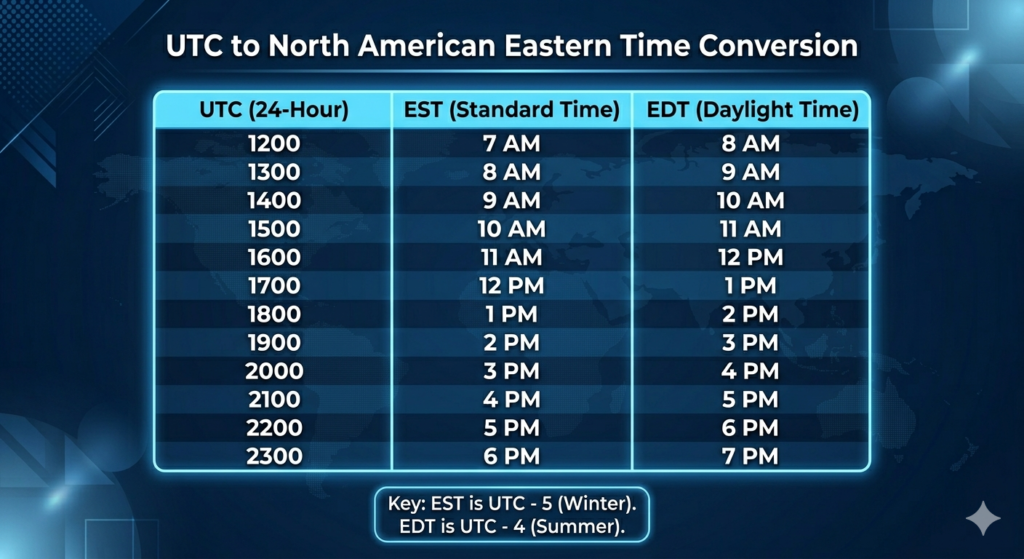
Military time UTC conversions come up all the time in professional settings. 1700 and 5 PM are exactly the same, just different formats. 1400 utc to est gives 9 AM winter or 10 AM summer. 1500 utc to est is 10 AM or 11 AM. 1600 utc to est lands at 11 AM or noon.
1700 utc to est is noon or 1 PM. 1800 utc to est becomes 1 PM or 2 PM. 1900 utc to est is 2 PM or 3 PM. 2000 utc to est is 3 PM or 4 PM. 2100 utc to est is 4 PM or 5 PM. 2200 utc to est is 5 PM or 6 PM. 2300 utc to est is 6 PM or 7 PM.
1200 utc to est is 7 AM or 8 AM. 1300 utc to est is 8 AM or 9 AM. 0800 utc to est is 3 AM or 4 AM. 0000 utc to est is 7 PM previous day or 8 PM previous.
Both EST and EDT answers matter because of the seasonal flip. This section covers the military formats people search most.
AM and PM UTC Times Converted to Eastern
UTC (Military Time) → Eastern Time (EST / EDT)
| UTC (24h) | EST (Winter) | EDT (Summer) | Note |
|---|---|---|---|
| 00:00 (0000) | 7:00 PM (prev day) | 8:00 PM (prev day) | 🔁 Previous day |
| 08:00 (0800) | 3:00 AM | 4:00 AM | |
| 12:00 (1200) | 7:00 AM | 8:00 AM | |
| 13:00 (1300) | 8:00 AM | 9:00 AM | |
| 14:00 (1400) | 9:00 AM | 10:00 AM | |
| 15:00 (1500) | 10:00 AM | 11:00 AM | |
| 16:00 (1600) | 11:00 AM | 12:00 PM | |
| 17:00 (1700) | 12:00 PM | 1:00 PM | |
| 18:00 (1800) | 1:00 PM | 2:00 PM | |
| 19:00 (1900) | 2:00 PM | 3:00 PM | |
| 20:00 (2000) | 3:00 PM | 4:00 PM | |
| 21:00 (2100) | 4:00 PM | 5:00 PM | |
| 22:00 (2200) | 5:00 PM | 6:00 PM | |
| 23:00 (2300) | 6:00 PM | 7:00 PM |
These am and pm examples help visualize everyday times.
UTC Plus 8 and Other Offset Zones to EST
Utc plus 8 to est means you’re dealing with a bigger gap. UTC plus 8 stays 13 hours behind during EST winter or 12 hours during EDT summer. 11 utc plus 8 to est works out accordingly after the subtraction. 10 utc plus 8 follows the same logic.
Cover utc plus 2 to est, utc plus 1 to est, utc plus 3 to est, and utc plus 0 to est. Utc minus 4 to est and utc minus 5 to est are edge cases people search. Utc 5 to est and similar variations fit the pattern. 23:00 utc minus 5 needs careful handling for the correct result.
UTC to EST for Developers and Timestamps
Developers need utc timestamp to est conversion for server logs, APIs, and databases. Hardcoding a static subtract five hours breaks every summer when daylight saving kicks in. Use proper timezone databases instead of fixed offsets to avoid bugs.
Common issue is storing in UTC but displaying wrong local time because DST wasn’t handled. Convert utc to et properly in code saves debugging time later.
The US Europe Scheduling Sweet Spot
1300 to 1500 UTC creates the golden overlap for US East Coast and Europe. 1300 UTC is 8 AM EST or 9 AM EDT and 2 PM in Central Europe. 1500 UTC is 10 AM EST or 11 AM EDT and 4 PM in Central Europe. This window works great for remote teams and global standups.
2026 Voice Search and AI Changes for Time Zone Queries
AI platforms now answer utc to est directly, which means 25 percent search volume drop is predicted by late 2026. Structured clear answers get cited more by tools like ChatGPT and Perplexity. 47 percent of organic traffic still flows through traditional search.
41 percent of adults use voice search daily with 8.4 billion voice assistants worldwide by 2026. 75 percent of voice answers come from top ranking pages. Mobile searches make up 62.73 percent, and pages with visuals see 88 percent longer engagement. Content with images gets 94 percent more views.
Common Mistakes When Converting UTC to Eastern Time
Biggest mistake is forgetting the EST versus EDT switch and using the wrong offset. Some apply subtract five hours year round and miss the summer change. Confusing direction on utc plus 8 to est happens too. Trusting converters that ignore daylight saving causes problems. 94 percent of web pages get zero traffic because they skip these details.
What Makes Eastern Time Unique Among US Time Zones
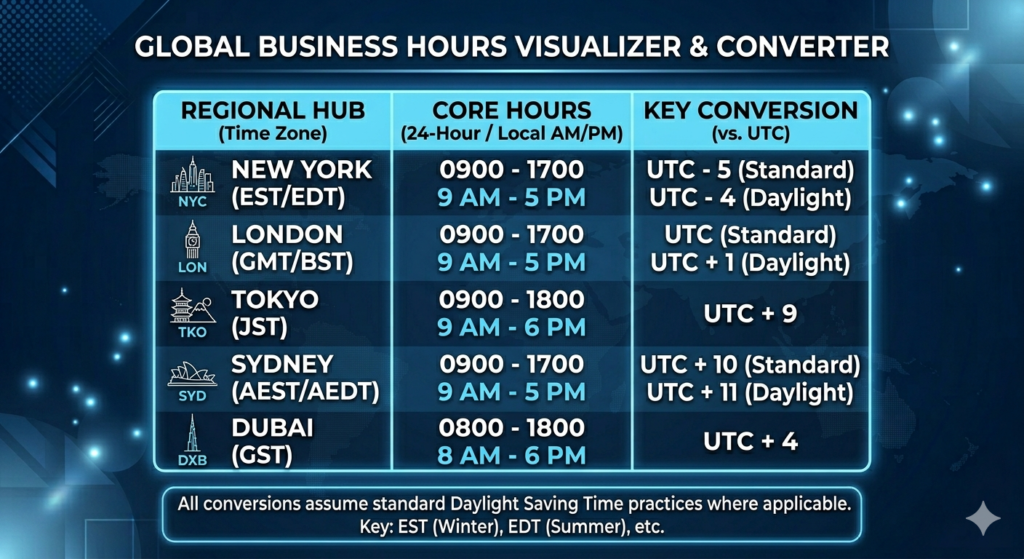
EST covers the biggest US population areas and hosts major financial markets that open at 9:30 AM Eastern, which is 14:30 UTC in winter. It serves as the default reference in American business.
How to Pick a Reliable UTC to EST Converter
A good utc to est converter handles daylight saving automatically, supports military time like 1400 utc to est, and shows both EST and EDT clearly. It should manage offsets like utc plus 8 to est. Compare options at UTC to EST.com, UTC to EST tools at utctime.net, and worldtimeserver.com converters.
EST to UTC | Reversing the Conversion
Est to utc means you add five hours in winter or four in summer. 9 AM EST becomes 14:00 UTC in winter. Convert est to utc helps when you need to share times globally.
Real Use Cases From Real People
One remote developer team fixed server log confusion by standardizing on UTC then converting to EST as needed. An international sales team cut missed calls dramatically. Gamers coordinated events better with a solid utc to est chart.
Quick Reference | UTC to EST Chart
This scannable utc to est chart repeats the full table for easy reference with clear previous day flags for early UTC hours.
Summary
Getting utc time to est right comes down to two rules. Subtract five hours in winter for EST and subtract four in summer for EDT. The tricky part is knowing which offset is active. Now you’ve got the full picture including overnight rollovers, military formats, offset zones, and daylight saving dates. Bookmark the UTC to EST Converter and you’ll never have to do the mental math again.
Ready to stop second guessing? Use the free UTC to EST Converter at utc to est and get the right answer fast.
FAQ,s
What is utc time to est and how is the conversion done?
Utc time to est simply means subtracting five hours during winter EST or four hours during summer EDT from the UTC time. For example, 17 UTC becomes noon in winter or 1 PM in summer. Check the current daylight saving status first because that one hour difference really changes things. Overnight UTC times from midnight to 4 AM shift to the previous day in Eastern Time. This straightforward approach works for quick mental math or when you use a converter. Honestly, once you remember the seasonal rule the rest feels pretty natural.
What is the difference between EST and EDT when converting from UTC?
EST is the winter offset five hours behind UTC while EDT is the summer version four hours behind. In 2026 DST ran from March 8 to November 1. Most people say EST all year but technically switch halfway through. The difference affects every conversion by one hour, so it pays to double check the date.